In Lake Bluff, the Lot Line and the Buildable Line Are Not the Same Line
September 17, 2026
September 17, 2026
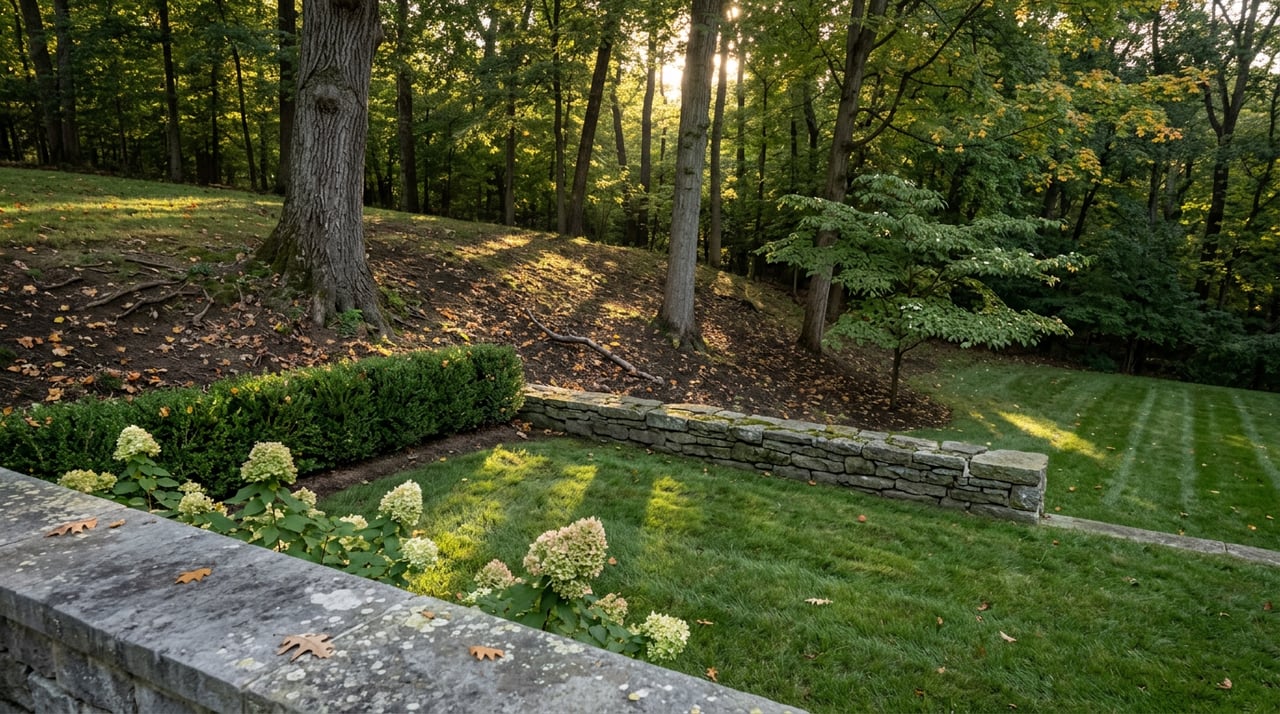
At one Village of Lake Bluff zoning hearing, a homeowner's representative made a point that should give any ravine-lot buyer pause: the plat of survey was misleading. Not wrong, exactly. Accurate as a legal description of the parcel. But the ravine edges on the ground ate so far into the lot that the land actually available to build on was a fraction of what the survey implied, and the representative argued the driveway length and lot shape created a genuine hardship as a result.
That is not a one-time complaint from a frustrated homeowner. It is how Lake Bluff's bluff and ravine rules work, and it is the thing most buyers do not learn until they are already under contract on a lot they assumed was theirs to build on exactly as platted.
Lake Bluff's zoning code has an entire chapter devoted to bluffs and ravines, Title 10, Chapter 12, with sections covering setback requirements, what can be built and where, and construction activity inside protection areas. That much is normal for a lakefront-adjacent village. What is not normal, and what most out-of-town buyers do not expect, is the override clause tucked into Section 10-12-2.
That section states plainly that the bluff and ravine provisions apply cumulatively with every other part of the zoning code, and that no permit issued under ordinary zoning rules authorizes anything that fails to also comply with the bluff and ravine chapter. If the two sets of rules ever conflict, the version that gives the bluff or ravine more protection wins, except where state or federal law limits that outcome.
In practice, this means a homeowner's normal setback allowance or building plan can be legally correct under the base zoning code and still get rejected, because the ravine chapter takes precedence whenever it disagrees. The rule applies generally and uniformly across every zoning district in the village, not just inside a handful of named subdivisions, so a ravine or bluff edge anywhere in Lake Bluff can trigger it.
The Village's own Plan Commission & Zoning Board of Appeals minutes show how this plays out, not as a hypothetical, but as a recurring category of case the board handles.
| Situation | What the owner wanted | What the chapter required |
|---|---|---|
| Ravine-edge lot | Full use of the platted lot for new construction | The board weighed the owner's argument that ravine edges left far less usable land than the survey suggested |
| Ravine lot with an existing pool | A standard hardscape patio | The board approved the patio only with pervious tile, after hearing that a solid surface would worsen mud accumulation on the slope |
| Bluff and ravine protection area project | Relief to proceed with construction | The Village required relief from three separate sections at once, setback requirements, building and structure rules, and construction activity limits, and the April 16, 2025 hearing was continued to a second meeting on May 21, 2025 |
The first two cases show how the chapter reshapes what "buildable" means on a ravine lot even after a variance is granted. The third case, filed by a contractor on behalf of a property owner seeking relief in a bluff and ravine protection area, shows the process itself. A single project needed sign-off under Sections 10-12-3, 10-12-4, and 10-12-5 simultaneously, and the board did not resolve it in one sitting. It took a second public hearing a month later. A buyer who assumes a spring closing means a summer groundbreaking on a ravine lot is planning around a timeline the Village's own process does not support.
A subset of Lake Bluff subdivisions add a private layer to the public one. The village's building permit guidelines specifically flag Tangley Oaks, Armour Woods, Wimbledon Court, and The Sanctuary as subdivisions where a homeowners association sign-off is required before the village will even process certain permits. For a buyer who has already priced in the ravine chapter's public review, an HOA approval step most listing sheets never mention can add another round of paperwork and another calendar dependency.
The practical lesson is not that these subdivisions are worse bets. Many of Lake Bluff's most established, tree-canopied streets carry exactly this kind of layered oversight because that oversight is part of what has kept the ravines intact for decades. The lesson is that a lot inside one of these four subdivisions, or any lot abutting a ravine or bluff anywhere in the village, needs a different due diligence conversation than a standard interior lot.
Here is the tension a design-forward buyer or seller should sit with. In August 2026, homes for sale in Lake Bluff spent a median of 26 days on the market, a pace that suggests a fast, straightforward process from offer to close. But that clock measures how quickly a home finds a buyer, not how quickly that buyer can act on plans that touch a ravine or bluff line.
The Hegwer petition that needed a second hearing a month after the first shows the other clock running underneath the market clock. A buyer who writes an offer assuming they can start construction on a ravine lot within weeks of closing is comparing the wrong two numbers. The Village's zoning board process, for lots where Chapter 12 applies, is not built to match the speed of a competitive real estate market. Lake Bluff's own description of its ravines notes they are fragile deposits left from the ice age, moraine glacial till laid on heavy clay, and that kind of terrain does not move at market speed either.
If a property you are considering in Lake Bluff sits on or near a ravine or bluff, or falls inside Tangley Oaks, Armour Woods, Wimbledon Court, or The Sanctuary, a few questions are worth asking before you get to inspection contingencies:
None of this makes a ravine lot a bad purchase. Many of the most desirable settings in the village exist precisely because the ravines have been protected this carefully for this long. It simply means the buildable footprint you can see on a plat of survey and the buildable footprint the village will actually let you use are two different documents, and the gap between them is worth closing before you are emotionally attached to a floor plan.
Does Chapter 12 only apply to lakefront bluff properties? No. The application section states the bluff and ravine provisions apply generally and uniformly across every zoning district in the village. A ravine that cuts through an interior lot away from the lake can trigger the same review as a bluff-top lot on the shoreline.
If my project only needs a setback variance, do I still have to deal with the rest of the chapter? Often, yes. The Hegwer petition needed relief from setback requirements, building and structure rules, and construction activity limits all at once, because the chapter's sections apply cumulatively rather than one at a time.
What is a ravine lot owner actually expected to do to maintain the slope? Village guidance describes specific ravine homeowner responsibilities: planting native material, fertilizing organically rather than with insecticides or herbicides, mulching, and not dumping leaves or grass clippings onto the slope. These are maintenance obligations that come with the lot, not just construction limits.
If you are weighing a ravine or bluff-adjacent property in Lake Bluff, or preparing one for sale and want to know how its zoning history might read to a prospective buyer, the Kim & Carleigh Team can walk through what the parcel's specific overlay means for your plans. Schedule a design-forward consultation before you write the offer, not after.
Stay up to date on the latest real estate trends.
Kim and Carleigh craft tailored marketing strategies that maximize impact and elevate every listing. Their results-driven approach delivers exceptional outcomes for buyers and sellers alike.

Kim Shortsle
Carleigh Goldsberry
560 Oakwood Ave Ste 101 Lake Forest IL 60045