Commuting From Lake Bluff to Chicago for Hybrid Living
July 2, 2026
July 2, 2026
If you need Chicago access but do not want your entire week to revolve around the city, Lake Bluff deserves a closer look. Many buyers today are balancing office days, remote work, and the desire for a home that feels calm, connected, and practical. In this guide, you’ll see why Lake Bluff can work so well for a Chicago commute or hybrid schedule, what daily life looks like, and which home features matter most as you search. Let’s dive in.
Lake Bluff sits about 35 miles north of downtown Chicago, which places it within reach for buyers who still head into the city during the week. The village also has a Metra station at 600 N. Sheridan Rd. on the Union Pacific North line, giving you a reliable rail option instead of relying only on driving.
That matters even more if your schedule is hybrid rather than fully in-office. You may not need the shortest possible commute every single day. Instead, you may want a home base that supports city access when needed, while giving you more breathing room the rest of the week.
Lake Bluff’s Metra service makes the village especially relevant for buyers who split time between home and downtown. Metra’s weekday UP-N timetable shows departures from Lake Bluff starting as early as 4:16 a.m. and continuing through the day, with Ogilvie Transportation Center as the Chicago terminal.
Based on the published schedule, many trips from Lake Bluff to downtown are roughly an hour. That is often a manageable tradeoff for buyers who are only commuting a few days a week and want more space and a different pace at home.
Commuter parking can shape your routine just as much as the train itself. In Lake Bluff, weekday Metra parking costs $3 from 6:00 a.m. to 10:00 a.m., is free after 10:00 a.m., free on weekends, and $5 overnight.
That setup adds useful flexibility. If your office day starts later, or if you only head downtown occasionally, the parking rules are easier to work with than an all-or-nothing commuter pattern. The village also says residents can pay by phone, which helps simplify the process.
The way people choose homes has shifted with remote and hybrid work. Census says 13.3% of workers worked from home in 2024, and the Bureau of Labor Statistics reported that 22.6% teleworked in March 2026.
That broader trend shows up in home search priorities too. In the 2024 Profile of Home Buyers and Sellers, convenience to one’s job fell to 34% from 52% in 2014, while neighborhood quality and convenience to friends and family became top factors.
For you, that can mean the right home is not just the one that cuts ten minutes off a commute. It may be the one that gives you a better daily rhythm, stronger separation between work and personal time, and easier access to the places you actually use during the week.
If you are buying in Lake Bluff with a hybrid schedule, a few features often rise to the top:
These are practical filters, but they also shape how a home lives day to day. A thoughtful layout can make a big difference when your house needs to support both focused work and real downtime.
One reason Lake Bluff stands out is that it offers more than a workable train ride. The village describes downtown as a compact, walkable center with civic uses, the Metra station, green space, restaurants, and retail.
Village planning materials also note that residents walk and bike between neighborhoods, parks, the beach, and downtown. For a hybrid household, that can make the week feel less car-dependent and more fluid.
On work-from-home days, convenience looks different. It may mean stepping out for coffee, picking up a quick errand, or taking a short walk at lunch without turning it into a major trip.
Lake Bluff’s layout supports that kind of routine. Rather than feeling like a place you simply return to after a city workday, it can function as a more complete home base throughout the week.
The village maintains parks and parkways including Village Green and Washington Park, and says it cares for about 50 acres of parks and parkway. That access to green space can be especially appealing when your workday starts at home.
Even a short walk can break up long stretches of screen time. For many buyers, that kind of built-in breathing room is part of what makes hybrid living feel sustainable.
Lake Bluff also hosts a seasonal Farmers Market on the Village Green on Friday mornings from June through October, from 7:00 a.m. to noon. Details like that may seem small at first, but they help show how local life can fit naturally into the workweek.
A hybrid schedule often gives you more chances to use your own community. In Lake Bluff, that can look like a train day on Tuesday, a focused home-office day on Wednesday, and a Friday morning market stop before logging on.
Lake Bluff is a compact community of 5,834 people across about 4 square miles, according to Census QuickFacts. The same source reports a 92.1% owner-occupied housing rate, a median value of owner-occupied homes of $776,700, and a median household income of $204,000.
Those numbers point to a largely owner-occupied community with a housing profile that aligns well with buyers seeking a long-term home base. If you want a place that supports both suburban living and periodic city access, Lake Bluff fits that picture.
The Census also lists the mean travel time to work at 28.4 minutes. While every buyer’s routine will differ, the broader takeaway is that Lake Bluff is not defined by a single pattern. It can serve people who commute, people who work remotely, and many who do a combination of both.
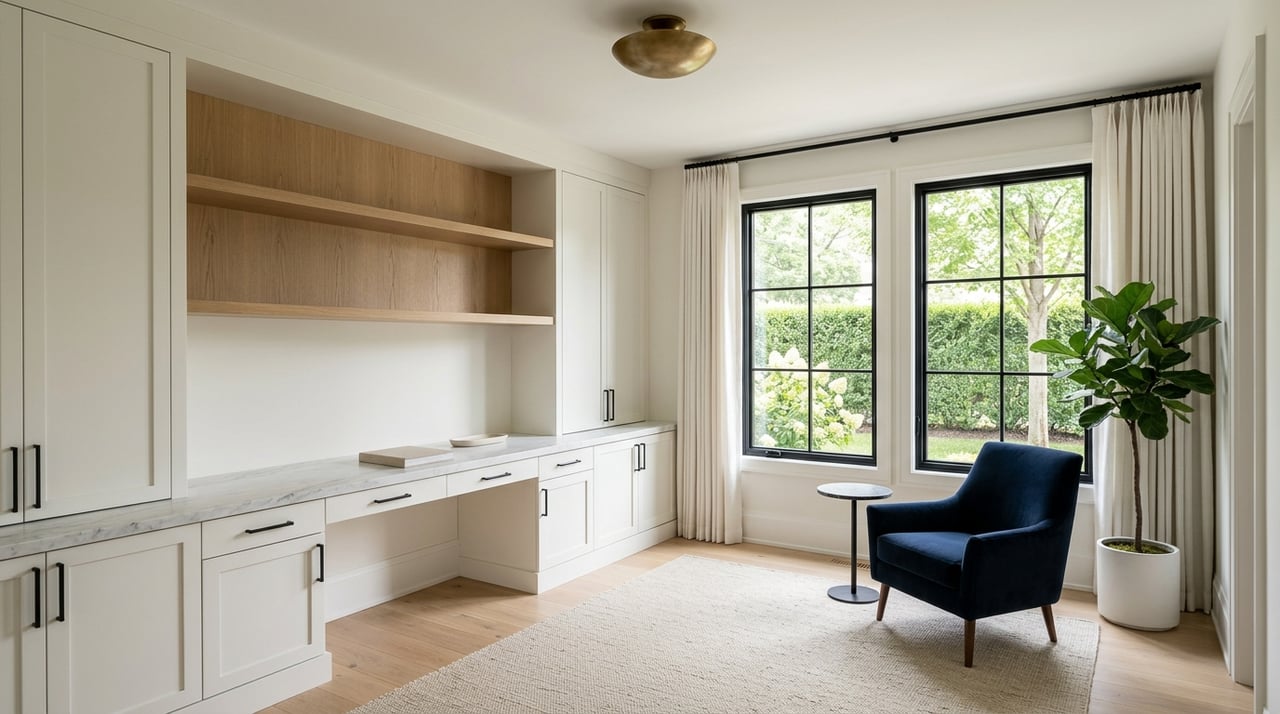
When you tour homes in Lake Bluff, it helps to think beyond square footage and bedroom count. Hybrid living tends to reward homes that work well in motion, not just homes that look good on paper.
A beautiful room can become even more valuable if it gives you privacy for calls, natural light for long work blocks, or flexibility as your schedule changes. The best fit is often the home that supports your routine with less friction.
Use questions like these as you evaluate options:
For many buyers, the answer is not about finding a perfect commute or a perfect home office in isolation. It is about finding the right blend of access, comfort, and daily ease.
National housing behavior helps explain why Lake Bluff resonates with today’s buyers. The National Association of Realtors reports that buyers are still most likely to purchase in suburbs at 45% and in small towns at 23%.
That pattern makes sense when you consider how many people now divide their week between office time and home time. If you no longer need to be downtown every weekday, a place like Lake Bluff can offer a more balanced equation.
You keep access to Chicago through Metra and major highways, while gaining a walkable downtown, parks, and a home environment that may support privacy and flexibility more naturally. For many buyers, that is exactly the point of a hybrid move.
If you are weighing Lake Bluff as your next home base, the right guidance can help you compare commute realities, neighborhood fit, and the kind of layout that supports your routine. To explore homes with a thoughtful, local perspective, schedule a design-forward consultation with the Kim & Carleigh Team.
Stay up to date on the latest real estate trends.

Kim and Carleigh craft tailored marketing strategies that maximize impact and elevate every listing. Their results-driven approach delivers exceptional outcomes for buyers and sellers alike.

Kim Shortsle
Carleigh Goldsberry
560 Oakwood Ave Ste 101 Lake Forest IL 60045